4 min read
Is Sintered Metal Strong Enough? Ending 7 Powder Metal Myths
COMTEC Manufacturing : Updated on August 25, 2026
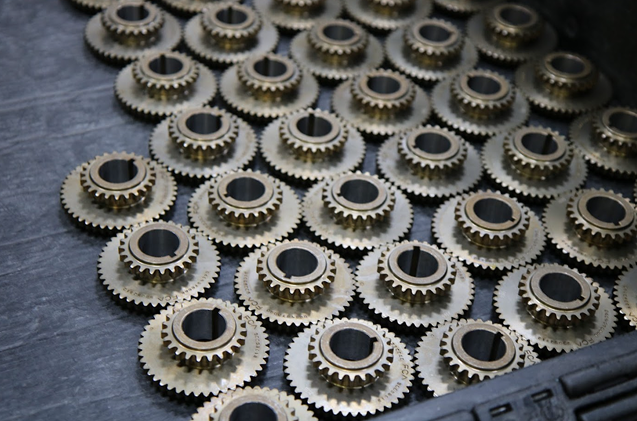
When engineers hear "powder metal," the first reaction is often skepticism.
Isn't it porous? Isn't it weaker than machined steel? Can it really handle demanding applications?
These misconceptions have followed powder metallurgy (PM) for decades. Yet today's powder metal components are found in automotive engines, hydraulic pumps, industrial equipment, power tools, and countless other high-performance applications where strength, precision, and repeatability matter.
The reality is that powder metal isn't an outdated manufacturing method. It's a mature technology that's been refined for nearly a century and continues to evolve through improved materials, advanced compaction methods, and sophisticated sintering processes.
7 Powder Metal Myths: Debunked
Powder metallurgy has come a long way, but outdated assumptions still prevent many engineers from considering it for new designs. Let’s address seven of the most common misconceptions about powder metal manufacturing.
- Powder metal isn't strong enough for demanding applications
- Powder metallurgy is outdated technology
- Powder metal can't produce precision parts
- Porosity always makes powder metal weaker
- Powder metal offers limited material options
- Powder metal can only produce simple geometries
- Lower cost means lower quality
1. Powder Metal Isn't Strong Enough for Demanding Applications
This is by far the most common misconception.
Many people assume that because powder metal parts contain controlled porosity, they must be soft or fragile. In reality, modern powder metal components can achieve hardness above HRC 40, depending on the material and heat treatment. They also reach densities between 6.5 and 7.1 g/cm³, approaching the density of fully dense steel at 7.87 g/cm³.
Strength comes from more than density alone.
During sintering, individual metal particles are heated to approximately 2,050 to 2,065°F, where they metallurgically bond together. Think of these connections as thousands of microscopic welds throughout the part. Once complete, the component behaves as a single engineered structure rather than a collection of loose particles.
For applications requiring additional hardness, manufacturers can also use sinter hardening or conventional heat treating to achieve even higher mechanical properties.
2. Powder Metal Is an Outdated Manufacturing Process
Powder metallurgy has been around for nearly 100 years, but that doesn't make it obsolete.
In fact, its maturity is one of its biggest strengths.
The Metal Powder Industries Federation (MPIF) has established 311 standardized material grades, giving engineers proven material properties backed by decades of testing. These standards allow designers to specify exact combinations of hardness, density, strength, and elongation with confidence.
Today's powder metal manufacturing also incorporates technologies that weren't available decades ago, including:
- Advanced alloy development
- Bonded powder blends that prevent segregation
- Precision multi-level compaction presses
- Sinter hardening
- Tight particle size control for demanding applications
Rather than replacing powder metal, newer technologies like metal injection molding (MIM) and metal 3D printing have simply expanded the manufacturing landscape. Each process has its place, but traditional powder metallurgy remains one of the most economical solutions for high-volume precision components.
3. Powder Metal Can't Produce Precision Parts
Precision is one of powder metallurgy's biggest advantages.
During compaction, powder is pressed under extremely high pressure, often 40 to 45 tons per square inch, inside precision tooling designed specifically for the part geometry.
Because the tooling creates near-net-shape components, manufacturers can produce parts with:
- Tight dimensional tolerances
- Excellent repeatability
- Minimal machining
- Consistent quality over hundreds of thousands or even millions of parts
When additional precision is required, secondary operations like sizing, coining, grinding, or machining can further improve dimensional accuracy while still keeping overall production costs significantly lower than machining an entire component from bar stock.
4. Porosity Is Always a Weakness
Controlled porosity is often viewed as a defect.
In powder metallurgy, it can actually become an advantage.
Depending on the application, manufacturers can leverage porosity to:
- Oil impregnate self-lubricating components
- Resin impregnate parts for sealing
- Copper infiltrate components to increase strength
Instead of treating porosity as a limitation, engineers often use it as another design tool to improve performance.
5. Powder Metal Limits Material Choices
Many engineers assume powder metal only uses pure iron. In reality, powder blends can be highly customized.
Common alloying elements include:
- Copper
- Nickel
- Molybdenum
- Manganese
- Carbon
Manufacturers can also create proprietary blends tailored to specific wear characteristics, dimensional stability, strength requirements, or customer applications. Some alloys are pre-alloyed before atomization, while others are blended afterward to achieve the desired performance.
This level of flexibility allows engineers to optimize the material itself instead of being limited to standard wrought steel grades.
6. Powder Metal Can Only Produce Simple Parts
Powder metal does have design rules.
Parts must generally be designed for axial compaction with straight-wall geometry. Features like undercuts or side actions aren't possible directly in the pressing operation.
That doesn't mean complex components are off the table.
Experienced powder metal manufacturers regularly combine:
- Near-net-shape compaction
- Strategic secondary machining
- Grinding
- Assembly operations
This hybrid approach often produces parts that would cost two to five times more if machined entirely from wrought steel.
7. Powder Metal Is Only Cost Effective Because It's Lower Quality
Cost savings come from eliminating waste. Unlike machining, where material is removed from solid bar stock, powder metallurgy starts with only the material needed to create the finished component.
The process also reduces:
- Scrap
- Machining time
- Material waste
- Secondary operations
- Cycle times for high-volume production
Because the process is highly repeatable, manufacturers can produce hundreds of thousands of identical parts while maintaining consistent quality and minimizing variation.
For high-volume production, few manufacturing processes can match powder metallurgy's combination of precision, material utilization, and overall cost efficiency.
Powder Metal Has Earned Its Place in Modern Manufacturing
When properly designed, powder metal components deliver:
- High strength
- Excellent dimensional consistency
- Custom material properties
- Minimal waste
- Exceptional value in high-volume production
The biggest challenge isn't the technology itself. It's overcoming outdated assumptions about what powder metal can and can't do.
For engineers evaluating manufacturing options, understanding the capabilities of modern powder metallurgy can open the door to lower costs, improved manufacturability, and components that perform just as well as traditionally manufactured alternatives.
Looking for the Right Manufacturing Process?
Choosing between powder metallurgy, machining, casting, or another manufacturing method isn't always straightforward. The best solution depends on your part geometry, material requirements, production volume, and performance goals.
The engineering team at COMTEC works with customers early in the design process to determine whether powder metal is the right fit and identify opportunities to reduce cost without sacrificing performance. Reach out to our team to discuss your application and explore your options.