Is Sintered Metal Strong Enough? Ending 7 Powder Metal Myths
When engineers hear "powder metal," the first reaction is often skepticism.
6 min read
COMTEC Manufacturing : September 21, 2026
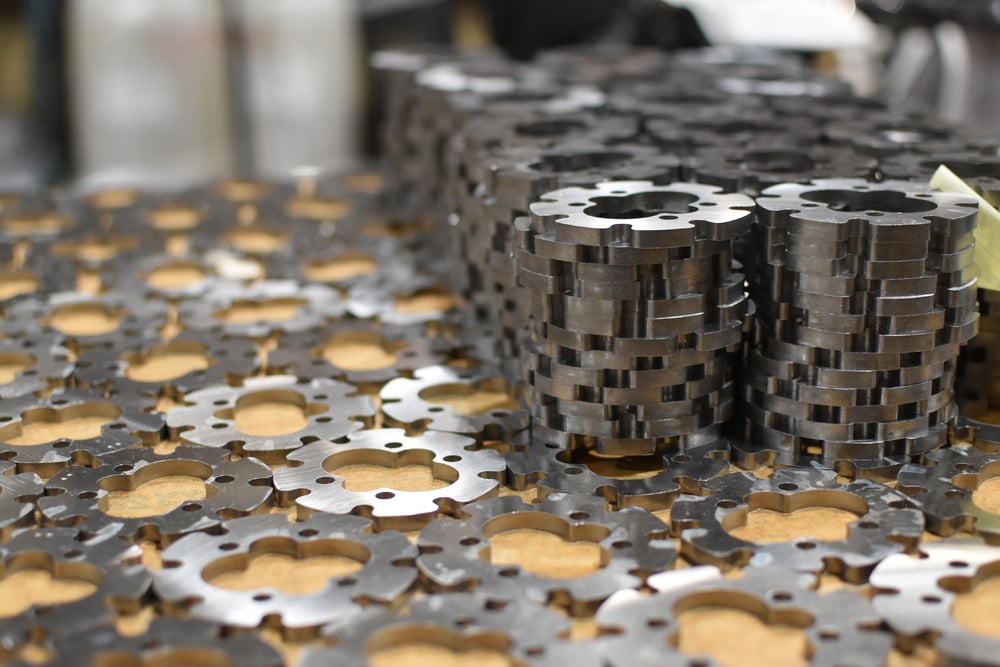
Reducing the cost of a metal component isn't always about finding a less expensive material or negotiating a lower machining rate. Sometimes, the bigger opportunity is changing how the part is made.
Traditional manufacturing methods can require starting with more material than the finished component needs, then machining that material away to achieve the required geometry. That adds material waste, machine time, tooling, labor, and secondary operations to the final part cost.
Near net shape manufacturing processes take a different approach. They produce components much closer to their final dimensions from the start, reducing the amount of material removal and finishing required.
Powder metallurgy (PM) is particularly well suited to near net shaping. By compacting metal powder in tooling designed around the finished component, PM can form many features directly into the part. For the right application, that can mean less material waste, fewer machining operations, and a lower cost per part without sacrificing the dimensions and performance the application requires.
Near net shape manufacturing processes produce a component that's close to its final dimensions and geometry. Some machining or finishing may still be necessary, but significantly less material needs to be removed than with a rough blank.
Net forming goes a step further. A net shape component is produced at, or very close to, its required final geometry without substantial secondary material removal.
The distinction comes down to how much additional processing is required.
A conventionally formed blank may need substantial machining before it's ready for use. A near-net component requires limited machining or finishing. A net shape component may require little to no material removal to achieve its final geometry.
Powder metallurgy can provide both net and near-net shape capabilities depending on the component.
In conventional PM, metal powder is compacted under pressure inside a precision die. The resulting “green” component is then sintered to bond the metal particles and develop its final properties.
Because the tooling creates the component's geometry during compaction, features that would otherwise require machining may be incorporated directly into the part design.
PM starts with a major advantage: You aren't cutting the desired component out of a much larger piece of metal.
Instead, the powder is placed where the part needs material and compacted into the desired geometry. This gives engineers opportunities to form features such as steps, bosses, certain holes, and other geometry directly into the component.
That doesn't mean every PM part comes out of the sintering furnace completely finished.
Depending on its tolerances and performance requirements, a component may still require operations such as sizing, coining, machining, grinding, heat treating, or surface finishing.
The difference is that these operations can be reserved for the features that actually need them.
That's an important consideration when comparing manufacturing methods. The goal of near net shaping isn't necessarily to eliminate every secondary operation. It's to eliminate unnecessary ones.
For the right component and production volume, designing around the net and near-net capabilities of powder metallurgy can affect costs throughout the manufacturing process.
Let’s take a look at the advantages:
Material utilization is one of the clearest benefits of powder metallurgy.
With machining, a manufacturer may begin with a billet, bar, forging, or other blank that's larger than the finished component. Material is then removed until the required geometry is achieved.
You're paying for all of that starting material, including the portion that eventually becomes chips or scrap.
PM approaches the component differently. Metal powder is compacted into a shape that's already close to the finished part, so substantially less material may need to be removed.
The potential savings become more significant as material prices and production volumes increase. If you're producing hundreds of thousands of components, even a relatively small reduction in material waste per part can add up.
Near net shaping can also reduce the number and extent of machining operations required after forming.
With PM, the tooling can be designed to create many of the component's features during compaction rather than cutting each feature into the part afterward.
Consider a component that currently requires multiple CNC operations to establish its final geometry. If some of those features can instead be formed into the PM component, the manufacturing process may require fewer machining setups and less overall machine time.
Secondary machining isn't inherently a problem. Sometimes it's the best way to achieve a specific feature or tolerance.
The question is whether you're paying to machine features that don't need to be machined.
Powder metallurgy requires dedicated tooling, so it's important to look beyond upfront tooling cost when comparing PM with other processes.
The economics become especially interesting at higher production volumes.
Once the tooling has been developed, it can produce the same geometry repeatedly. The initial tooling investment can then be distributed across a large number of components while material and machining savings continue with every part produced.
That means procurement teams shouldn't evaluate PM based on tooling cost alone.
A more useful comparison is total cost per finished component.
That calculation can include raw material, material waste, machining time, machine setups, tooling and tool wear, labor, secondary operations, inspection, scrap, and annual production volume.
A process with a higher upfront investment may produce a lower cost per finished part over the life of a high-volume program.
Near net shaping can also change how engineers think about part geometry.
Features that require separate machining operations with another manufacturing process may be candidates for forming directly into a PM component.
That's where designing specifically for powder metallurgy becomes important.
Simply converting an existing machined component to PM without considering how the PM tooling works can leave cost-saving opportunities on the table. An experienced PM manufacturer can evaluate the geometry and identify where features might be combined, formed differently, or incorporated into the tooling.
The result can be a component that's designed around the strengths of the manufacturing process rather than forcing PM to duplicate a design created for machining.
Dedicated tooling doesn't just create geometry. It creates that geometry repeatedly.
Once the PM process and tooling have been established, components can be produced consistently across high production volumes.
This can reduce reliance on repeated machining setups for features that can be controlled through the PM process.
For procurement teams, that repeatability matters when a program needs thousands or millions of components over its lifetime. Cost savings aren't as valuable if the manufacturing process can't consistently deliver acceptable parts.
This is often one of the first questions engineers and procurement teams have when considering PM.
If machining is reduced, can the component still meet its dimensional requirements?
The answer depends on the part.
PM has dimensional capabilities that make net and near-net production possible for many components, but not every dimension or tolerance should automatically be produced as formed.
The better approach is to identify which dimensions actually affect the function of the component.
A feature related to fit, sealing, alignment, wear, or another performance requirement may justify tighter control. Other dimensions may have more flexibility without changing how the part performs.
Some dimensions can be controlled through the initial PM process. Others may benefit from secondary operations such as sizing, coining, grinding, or machining.
That combination is what makes near net shaping useful.
You don't have to choose between a completely finished PM component and a heavily machined one. Instead, the part can be designed so the PM process establishes as much of the geometry as practical, then secondary operations are applied selectively where tighter tolerances require them.
This can help control costs without relaxing the dimensions that actually matter.
There's no single feature that makes a component a good candidate for near net shaping with powder metallurgy. The opportunity comes from looking at the part and its production requirements together.
Higher production volumes can make PM attractive because dedicated tooling costs can be distributed across more parts. But volume alone doesn't determine whether a conversion makes sense.
A manufacturer should also consider the amount of material currently being removed, the number of machining operations required, part geometry, tolerance requirements, material selection, and expected program life.
Components that require multiple machining setups or substantial material removal can be especially worthwhile to evaluate. The same is true for parts with features that could potentially be formed directly into PM tooling.
This is where reviewing the finished component rather than simply comparing individual manufacturing operations becomes important.
The value of near net shape manufacturing processes ultimately comes down to producing the required component with fewer unnecessary steps.
For the right application, powder metallurgy can get the component close to its finished geometry during the primary forming process. That can reduce material waste, limit secondary machining, and support a lower per-part cost at production volumes.
But those savings depend on the design, tolerances, material, volume, and performance requirements of the application.
Determining whether an existing component is a good candidate for PM isn't always obvious from the print alone. Working with a powder metallurgy manufacturer during the design or conversion stage can help identify which features can be formed, where secondary operations are still needed, and where DFM changes could reduce the total cost of the finished component.
To discuss your application and detremine what's best, reach out to our team at COMTEC Manufacturing.
When engineers hear "powder metal," the first reaction is often skepticism.
Heat treatment can change the hardness, wear resistance, surface condition, dimensional stability, and machinability of a powder metal part. But the...